
Media release: New research shows a rapid increase in Christian persecution
Violent Syria and sub-Saharan Africa face a crisis
More than 388 million Christians around the world now face high levels of persecution and discrimination for their faith (up by 8 million from last year’s figure of 380 million) – a record number, representing one in seven Christians worldwide (up from one in eight five years ago), one in five Christians in Africa and two in five Christians across Asia. A shocking 13 Christians are killed every day for their faith across the world.
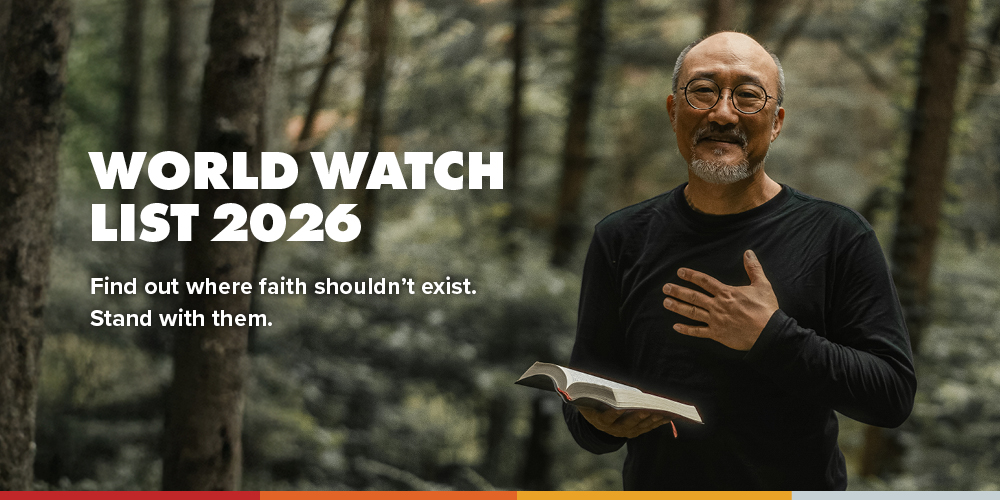
These are the disturbing findings of Open Doors International’s 2026 World Watch List (WWL), released on 14 January 2026. This annual list, now in its 33rd year, ranks the top 50 countries where Christians face the most extreme persecution and discrimination worldwide and creates awareness of the hardships that persecuted Christians face every day. Countries are ranked by the severity of persecution and discrimination endured by the Christians who live in them.
In this worldwide survey, the overall trend shows that the persecution of Christians has risen at an alarming rate all over the world. In the WWL top 50 countries alone, 315 million Christians face very high or extreme levels of persecution and discrimination for their faith. During the past year, many shocking incidents of persecution in Africa and elsewhere reached the news headlines.
Some of the biggest concerns on this year’s list are the violent surge in persecution in Syria, the religiously motivated killing of Christians in Nigeria, the enormous scale of persecution across sub-Saharan Africa, and the global pattern of churches driven underground by surveillance and heavy regulations.
Top 5 countries
North Korea once again holds the number one spot on the World Watch List for the fourth straight year and the 24th time since the first WWL in 1993. This country has been the most dangerous place for Christians to live for 29 of the last 30 years, with Christians and their families being deported to labour camps or executed. Since 2002, North Korea has been no. 1 every year but 2022, when it ranked second to Afghanistan in the wake of its fall to the Taliban.
This year, the violence score in North Korea rose even further, with Christians facing possible public execution if they are discovered. Despite this, China (15) is arresting and repatriating hundreds of North Korean (1) escapees as “illegal immigrants” with no concern for the fate they face – a fate considerably more severe for Christian converts.
Somalia is once again in the second place this year – the same as last year. Yemen follows in third place, Sudan in fourth place and Eritrea in fifth place.
Violence against Christians surges in Syria
This year, Syria (6) has recorded the largest rise on the WWL – jumping twelve positions from number 18 in 2025 to number 6 this year, becoming the only newcomer to the WWL top 10. Syria has leapt into the top 10, with a massive surge in reported violence towards its Christian minority. It follows the fall of Bashar al-Assad’s presidency in December 2024 and has led to thousands of Christians fleeing the country.
The spike in violence and persecution for Christians was mostly caused by a strong increase in the number of reported Christians killed, churches attacked and Christian schools being closed. A total of 27 Christians were killed in the reporting period, with a suicide attack at a Damascus church in June 2025 claiming 22 lives.
Syria’s interim constitution establishes Islamic jurisprudence as the main source of legislation. Vehicles equipped with loudspeakers now roam the Christian neighbourhoods of Damascus, exhorting residents to convert to Islam. Meanwhile, several churches have had threatening messages painted on their walls. The Christian population is dwindling, as Open Doors estimates that only 300 000 Christians remain in the country – down from 1,1 million in 2015.
Unfolding tragedy in Nigeria
The religiously motivated killing of Christians in Nigeria (7) has sharply risen in this year’s reporting period. The data clearly shows that Christians are targeted in a picture that is mirrored across several sub-Saharan African nations. Of 4 849 Christians known to be killed worldwide for their faith during the reporting period, 3 490 were Nigerian – an increase from 3 100 the previous year and 72% of the total. A total of 3,4 million Nigerians were internally displaced.
Nigeria has been ranked in the top 10 since 2021 and has been appointed as the most violent country for Christians for eight consecutive years. Multiple terror groups such as Lakurawa, Mahmuda, Ansaru, Boko Haram, Islamic State West Africa Province (ISWAP) and the Fulani militants are active in the country.
The country has drawn international attention, following a series of deadly attacks against Christian communities, the mass kidnapping of 303 schoolchildren and 258 people (mostly women and children) killed in a Yelwata attack in June 2025. This prompted condemnation and then intervention by United States (US) President Donald Trump, who launched an attack on terror groups in Nigeria on 26 December 2025.
The data recorded in this year’s reporting period shows that, in most northern states, Christians have clearly been disproportionately targeted. These include:
- Benue State in north-central Nigeria, where 1 310 Christians were killed.
- Plateau State in north-central Nigeria, where 546 Christians were killed.
- Taraba State in Northeast Nigeria, where 73 Christians were killed.
- Northwestern Kaduna State, where 1 116 Christians were abducted in 2025.
Dark picture in sub-Saharan Africa
The scale of persecution across sub-Saharan Africa (SSA) is staggering, with 14 nations in this region on the 2026 WWL and one in every eight Christians globally living in these 14 countries. Three of these, Sudan (4), Nigeria (7) and Mali (15), have the maximum possible score for violence – the only three such nations in the world. Four of the top 10 countries on the list are now from sub-Saharan Africa.
Violence scores across SSA have surged drastically. Ten years ago, the twelve sub-Saharan countries on the list had a combined violence score that was 49% of the maximum possible score. In 2026, the combined violence score of the 14 sub-Saharan African countries on the list, comprising 721 million people (nearly half of whom are Christian), represents 88% of the maximum possible score.
A similar pattern can be seen across the region: Islamist militants enter the vacuum in law and order left by weak governance, war and civil conflicts. It means they can operate with impunity across parts of Nigeria (7), Burkina Faso (16), Mali (15), the Democratic Republic of the Congo (29), the Central African Republic (22), Somalia (2), Niger (26), Mozambique (39), Sudan (4), Ethiopia (36), Eritrea (5) and Comoros (43). Their stated aim is to create “Sharia states” operating under their deadly interpretation of Islamic law.
Open Doors currently runs the Arise Africa campaign, a multi-year response to the persistent violence waged upon Christians in sub-Saharan Africa. Working with Christian leaders throughout sub-Saharan Africa, the campaign aims to enable the African church to stand in faith where persecution is most extreme.
Churches driven underground
The 2026 WWL also shows another troubling global pattern: Churches and Christians driven underground by surveillance and crippling regulations, examples including Algeria (20) and China (17).
In Algeria, all 47 Protestant churches have now been forced to close, pushing Christians into isolation. The pressure is felt online too, with authorities shutting down a Christian Facebook group with more than 50 000 followers and blocking church activities. More than 75% of Algerian Christians have lost connection to a church fellowship.
Similar dynamics play out in China. Regulations put in place in September 2025 for online behaviour prohibit Bible apps, fundraising and outreach to the youth, and require religious leaders to openly support the Chinese Communist Party. Intensive surveillance, both human and technological, has forced China’s independent house churches to fragment, downsizing from large commercial gatherings into covert groups of 10 to 20 people in private homes.
This pattern can also be seen in Mauritania (21), Tunisia (31) and Vietnam (55), where tighter bureaucratic control, surveillance and vague regulations are systematically isolating Christians from any means of meeting to pray, study or worship. In Mauritania, people can get the death penalty for apostasy from Islam. In Tunisia, the authoritarian return in 2021 caused intensified surveillance, raids on church gatherings and the arrest of foreign Christians.
Most important general trends
The most important general trends of the 2026 WWL are:
- The total number of Christians killed for their faith increased from 4 476 cases in the WWL 2025 to 4 849 in the WWL 2026 reporting period.
- The number of churches or public Christian properties attacked in differing forms of severity decreased from 7 679 to 3 632 cases.
- The number of Christians detained for their faith decreased from 3 604 to 3 414 cases.
- The number of Christians sentenced for their faith increased from 1 140 to 1 298 cases.
- The number of Christians abducted for faith-related reasons decreased from 3 775 to 3 302 cases.
- The number of cases of Christians raped or otherwise sexually harassed for faith-related reasons increased from 3 123 to 4 055 cases.
- The same applies for cases of forced marriages of Christians to non-Christians: The number increased from 821 to 1 147 cases.
- The number of cases of Christians who have been otherwise physically or mentally abused for faith-related reasons (including beatings and death threats) increased from 54 780 to 67 843 cases.
- There were 20 084 cases of houses or other property (excluding shops) of Christians attacked in the WWL 2025 reporting period. This number decreased to 17 609 in the WWL 2026 reporting period.
- The number of cases of shops or businesses of Christians being attacked decreased from 8 284 to 8 185 cases.
- Because of violence – and also pressure (especially where converts had to leave their homes and communities) – the number of Christians forced to leave their homes or go into hiding in-country for faith-related reasons increased from 183 709 to 201 427 cases.
- The number of Christians forced to leave their country for faith-related reasons decreased from 26 062 to 22 702 cases.
Bible Access List
The Bible Access List was published on 2 October 2025 by Open Doors International and the Digital Bible Society in collaboration with other like-minded organisations. This list, covering 88 countries, identifies the countries where access to Scripture is most restricted and where Bible shortages are most severe.
The research shows a close connection between persecution and access to the Bible. Oppressive governments, extremist groups and extended families understand that cutting believers off from Scripture weakens their faith and fractures their communities. In countries where Christians face the greatest persecution, they also face the greatest barriers to accessing God’s Word.
Open Doors’ WWL data was used to help determine where persecution creates an environment where access to God’s Word is difficult. Many of the countries near the top of the WWL are also at the top of the Bible Access List’s restrictions list, which underlines the reality that believers in many of the world’s most dangerous places are cut off from God’s Word because of persecution. The report estimates that Christians who desire the Bible have considerable access restrictions in more than 50 countries.
Freedom of religion or belief
Lynette Leibach, executive director of Open Doors Africa, says: “Freedom of religion or belief is a basic right – yet religious identity significantly increases Christians’ vulnerability to discrimination and persecution.
“The 2026 WWL places the spotlight on hotspots like Syria and Nigeria, whilst the trends show how widespread persecution and discrimination against Christians are. The 388 million represent individuals, families and communities – each with a context, story and face – they are not just a number. Each one needs comfort and courage to face their reality. Open Doors and our partners work towards that.”
About the WWL and research methodology
The first WWL was produced in January 1993. Countries’ overall persecution scores are an amalgamation of six different scores: Pressure levels in private life, family life, community life, national life and the life of church communities, along with violence levels. Government restrictions and the amount of social hostility towards Christians are also taken into account. This year’s list covers the period from 1 October 2024 to 30 September 2025.
Released at the beginning of each year, the list uses extensive research, data from Open Doors field workers, their in-country networks, external experts and persecution analysts to quantify and analyse persecution worldwide. Each edition is audited and verified by the International Institute for Religious Freedom.
More information
Visit www.opendoors.org.za to download the full 2026 World Watch List and view the top 50 country profiles and persecution statistics.
For any questions about the 2026 World Watch List, the research methodology or to arrange an interview, please contact Elizabeth Botha, media officer, at [email protected], 083 227 8164 or 011 888 9341.
Open Doors Africa is part of the Open Doors International ministry, which serves persecuted Christians in over 70 countries across the world by delivering Bibles and Christian literature, visiting persecuted Christians, providing discipleship and training, and speaking out and raising awareness through advocacy.
Media release issued by Elizabeth Botha
Media officer: Open Doors Africa
Tel: 083 227 8164 / (011) 888 9341
E-mail: [email protected]
*WWL country rankings in brackets throughout the document.
This media release is available for download in Afrikaans. Click below for the pdf.