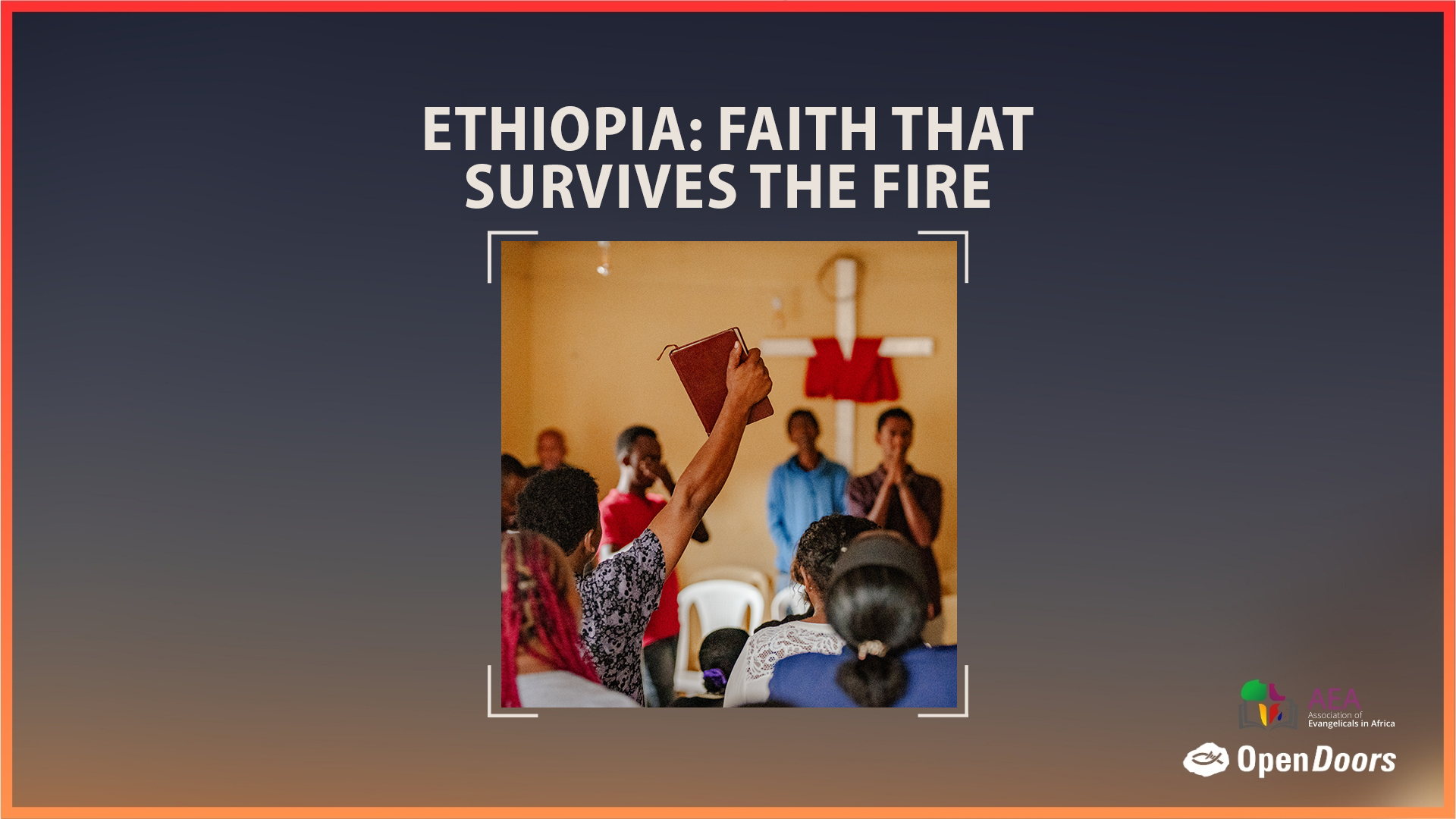
Welcome to our Arise Africa podcast in partnership with the Association of Evangelicals in Africa. Arise Africa is a campaign which aims to bring sustained awareness to the problem of extremist violence and its impact on Christians in Sub-Saharan Africa. In this interview, you’ll gain insights of what is happening in terms of the violent persecution in Africa.
We are joined by Ilya who works for Open Doors International as Senior Analyst for Freedom of Religion and Belief in Sub-Saharan Africa. He is a published writer, radio journalist and researcher. He has been covering news and human rights issues in Africa for more than two decades.
Thank you very much. Let me first greet you in the name of our Lord Jesus Christ. It’s an honour for me, but also a privilege to share a little bit about this experience of persecution affecting the church in Africa.
Islamic insurgency, generally speaking, has become the key factor or the key persecution engine of Christians in Sub-Saharan Africa. Now all observers or analysts agree that Sub-Saharan Africa has become the new epicentre of terrorism. It means that a new region, when we consider the geography, the whole Sub-Saharan Africa is now affected by Islamic insurgency.
All the major Islamic group or terror group, jihadist group, so Islamic State or Daesh or Al-Qaeda, now they are operating from Africa. There is a shift from the Middle East, from Iraq, from Syria, now to Africa. There is a shift from Afghanistan.
Al-Qaeda now is operating in Africa. So you can see in the Sahel region, particularly in West Africa, there are two main groups. The support group for Islam affiliated to Al-Qaeda, but also Daesh, Islamic State in the Greater Sahara, operating in West Africa.
But not only there, Northern Nigeria, Northeastern Nigeria, but also in Niger, Chad, Cameroon. We can see there is now a group called Boko Haram, which has also a branch affiliated to Islamic State, but also the central part of Africa. In Eastern DRC, there is one group called ADF, the Allied Democratic Forces, which is an Islamic State province for Central Africa.
It’s operating in Eastern DRC, affecting Christians there, but not only Eastern Central Africa, even the southern part of the continent is affected. There’s one group active in Northern Mozambique, which is also called known as Al-Shebaab, clear affiliation to Islamic State. So when we consider the geography, we can see clearly Africa or Sub-Saharan Africa has become now the new epicentre of jihadism.
And the church is under attack there. Christians are under attack. Violent displacement is a major issue facing many people.
Attacks from Islamic militant groups like Boko Haram and Islamic State West Africa province have led to thousands of Nigerians fleeing their homes for safety. Born in West Africa, Ilya shares how Islamic insurgency is wreaking havoc and how the church should be aware of millions of displaced Christians because of this violence. This is a clear illustration of how it started in northern Burkina Faso.
Burkina is a West African country known for its culture of tolerance, but this culture of tolerance is now undermined by Islamic insurgency. The story of Pastor Pierre Ouedraogo, it was on Sunday, 28th of April. Pastor Pierre Ouedraogo, just after the Sunday service, was still in the church when Islamic militants stormed the building and eventually asked for him and others, five elders of his church, to come out.
They asked him, they asked them to convert to Islam, but he refused to convert. And eventually they took him and including the five elders, they were all killed that day, on 28th of April, 2019, in northern Burkina Faso. This is the first among others, this is how and eventually from one targeted killing to another, from one village to another, today we can clearly say that there is no Christian presence in northern Burkina Faso.
And across, what happened in Burkina Faso is happening in Mali, it’s the same situation in Niger and across of Saharan Africa. Ilya also shares how Islamic extremists like Boko Haram are targeting schools in sub-Saharan Africa in order to control education. Schools and educators are often targeted by extremists, leading to closures, attacks, and threats that disrupt education.
Many children lose access to basic education and literacy. Without education, children become more vulnerable to recruitment by extremist groups, perpetuating the cycle of violence. In the same way, schools are also targeted because for them, schools are synonymous of Western education, Christian civilisation, and because of that, they are attacking and targeting schools.
That’s why in northeastern Nigeria, we have one group called Boko Haram, which is widely non-active in northeastern Nigeria since 2009. Boko Haram is an Arabic word or expression meaning Western education or Western school civilisation is forbidden. Boko Haram, Boko school, Haram, forbidden.
So that’s the ideology, that’s the rationale, that’s why they are attacking schools the same way they would attack Christians. So across the whole of sub-Saharan Africa, what we need to observe is this increased religious extremism. There is an Islamic revival.
Across the West and Central African region, more than 14,000 schools are closed. More than 5.5 million children are out of school because of that, and it’s probably more than that. Yes, it’s true the persecution of Christians in sub-Saharan Africa is underreported in the global media.
Very few people are aware of the extreme violence. That’s the aim of the Arise Africa campaign. Churches in sub-Saharan Africa are calling upon the Body of Christ around the world to stand with them, as one, to stop the violence and start the healing.
The Bible says, if one part of the body suffers, all the other parts suffer with it. This is a biblical mandate. We as Christians in South Africa, elsewhere in Africa, we need to pay attention and stand against this because it’s a biblical mandate.
The Bible said we are one body in Christ. We are forming one church, and when a member suffers, others suffer as well. So when we see how the church is affected in Burkina Faso, in Eastern DRC, in Somalia, or in Northern Mozambique, yes, we need to pay attention because we have this biblical mandate to express our compassion, to pay attention.
The Body of Christ is affected. It’s an urgent matter to consider because this violence is not covered. Media, international media, secular media, are not covering it, are not paying attention.
They are more focused on what is happening in Gaza, in Palestine, in Ukraine, but not in Sub-Saharan Africa. And we have seen this is a major situation. The violence across Sub-Saharan Africa has created a major crisis, a dramatic humanitarian crisis for millions displaced across the region.
But the media are not paying attention. So we need to pay attention and stand because Africa matters. Yes, it’s time to act for us, to stop the violence and start the healing.
Thousands are affected. Millions of people are displaced. That’s why Open Doors launched this multi-year campaign, Arise Africa.
Yes, Africa matters. Yes, it’s time for us to stand, to act. We want to stand to stop the violence and start the healing.
As we wrap up, Ilya calls on all of us to take action. This isn’t just a distant issue. It’s about our brothers and sisters who desperately need our help right now.
Join our campaign today. Your voice matters. Every signature on our Arise Africa petition sends a powerful message that we stand united against persecution.
Imagine the impact we can make together. Let’s be the change they need and show that we won’t stand by while they suffer. Stand up, speak out and help us bring hope where it’s desperately needed.
Together, we can make a real difference and let Africa arise.
Transcribed by TurboScribe.